

Old Mutual:
has unbundling benefited shareholders?

Old Mutual officially returned to its African roots on 26 June this year, when Old Mutual Limited started trading on the JSE, where it now has its primary listing. Quilter PLC was unbundled to Old Mutual shareholders during the same week. Last month, we argued that the so-called ‘managed separation’ of Old Mutual should be beneficial for shareholders. How has this played out so far?
Former Old Mutual PLC shareholders would have received one Quilter PLC share and three Old Mutual Limited shares for every three Old Mutual PLC shares owned. We can therefore compare shareholders’ current position to their pre-unbundling position by adding a third of the share price of Quilter PLC (currently R27.40) to the share price of Old Mutual Limited (currently R28.90).
At the time of writing this equated to R38, which, importantly, is still 5% below the R40 share price that Old Mutual PLC was trading on back in March 2016 when it announced it would be embarking on the separation. Shareholders have therefore not seen any benefit from the promised value unlock – in contrast to a number of lawyers and investment bankers who assisted with the process.
Despite our disappointment with the lack of shareholder wealth creation so far, we do believe Old Mutual Limited is currently undervalued and that the cleaner structure, potential for return of capital, and future unbundling of Nedbank will lead the market to ascribe the appropriate value for Old Mutual Limited over time.
The separate listings of Old Mutual Limited and Quilter have resulted in the exclusion of these shares from large developed market indices like the UK FTSE 100. This has likely created short-term selling pressure on the shares as index tracking funds were forced to sell them irrespective of their perceived value.
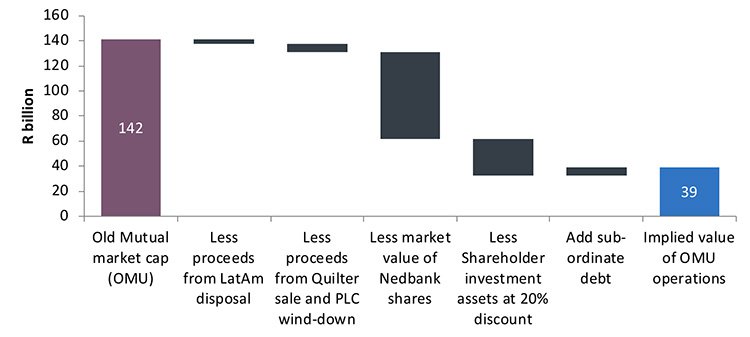
One way of looking at Old Mutual Limited’s current valuation is to strip out the following items from its market cap to derive the market-implied value for the local insurance, lending and asset management operations (Old Mutual Limited operations), as depicted in the graph below:
Sanlam Private Wealth manages a comprehensive range of multi-asset (balanced) and equity portfolios across different risk categories:

Nedbank’s value is based on its current listed market value, while the other assets are or will be liquid assets, so the valuations of these are quite straightforward. Stripping out these assets, we calculate a market-implied value of R39 billion for the Old Mutual operations.
After adjusting for disposals, additional operating cost as a stand-alone business, minorities and targeted cost savings, we estimate that these operations should generate around R7.8 billion in profit after tax this year. In effect, investors are therefore picking up the Old Mutual Limited operations at a five-times normalised price-to-earnings (PE) ratio, which is a material discount to its competitors. Sanlam, for example, trades on a 15-times PE.
Old Mutual will unbundle around 33% of its 53% stake in Nedbank over the next six months. We further hope that Old Mutual’s management will distribute the proceeds of LatAm, Quilter and the residual PLC to shareholders as a special dividend or share buyback over the near term. This should place more emphasis on the attractive valuation of the Old Mutual Limited operations and finally unlock value for shareholders.
Sanlam Private Wealth manages a comprehensive range of multi-asset (balanced) and equity portfolios across different risk categories:
A different approach to wealth
Partner with Sanlam Private Wealth for clarity, confidence and control over your financial future.
Contact us to schedule a private client consultation.
South Africa
South Africa Home Sanlam Investments Sanlam Private Wealth Glacier by Sanlam Sanlam BlueStarRest of Africa
Sanlam Namibia Sanlam Mozambique Sanlam Tanzania Sanlam Uganda Sanlam Swaziland Sanlam Kenya Sanlam Zambia Sanlam Private Wealth MauritiusGlobal
Global Investment SolutionsCopyright 2019 | All Rights Reserved by Sanlam Private Wealth | Terms of Use | Privacy Policy | Financial Advisory and Intermediary Services Act (FAIS) | Principles and Practices of Financial Management (PPFM). | Promotion of Access to Information Act (PAIA) | Conflicts of Interest Policy | Privacy Statement
Sanlam Private Wealth (Pty) Ltd, registration number 2000/023234/07, is a licensed Financial Services Provider (FSP 37473), a registered Credit Provider (NCRCP1867) and a member of the Johannesburg Stock Exchange (‘SPW’).
MANDATORY DISCLOSURE
All reasonable steps have been taken to ensure that the information on this website is accurate. The information does not constitute financial advice as contemplated in terms of FAIS. Professional financial advice should always be sought before making an investment decision.
INVESTMENT PORTFOLIOS
Participation in Sanlam Private Wealth Portfolios is a medium to long-term investment. The value of portfolios is subject to fluctuation and past performance is not a guide to future performance. Calculations are based on a lump sum investment with gross income reinvested on the ex-dividend date. The net of fee calculation assumes a 1.15% annual management charge and total trading costs of 1% (both inclusive of VAT) on the actual portfolio turnover. Actual investment performance will differ based on the fees applicable, the actual investment date and the date of reinvestment of income. A schedule of fees and maximum commissions is available upon request.
COLLECTIVE INVESTMENT SCHEMES
The Sanlam Group is a full member of the Association for Savings and Investment SA. Collective investment schemes are generally medium to long-term investments. Past performance is not a guide to future performance, and the value of investments / units / unit trusts may go down as well as up. A schedule of fees and charges and maximum commissions is available on request from the manager, Sanlam Collective Investments (RF) Pty Ltd, a registered and approved manager in collective investment schemes in securities (‘Manager’).
Collective investments are traded at ruling prices and can engage in borrowing and scrip lending. The manager does not provide any guarantee either with respect to the capital or the return of a portfolio. Collective investments are calculated on a net asset value basis, which is the total market value of all assets in a portfolio including any income accruals and less any deductible expenses such as audit fees, brokerage and service fees. Actual investment performance of a portfolio and an investor will differ depending on the initial fees applicable, the actual investment date, date of reinvestment of income and dividend withholding tax. Forward pricing is used.
The performance of portfolios depend on the underlying assets and variable market factors. Performance is based on NAV to NAV calculations with income reinvestments done on the ex-dividend date. Portfolios may invest in other unit trusts which levy their own fees and may result is a higher fee structure for Sanlam Private Wealth’s portfolios.
All portfolio options presented are approved collective investment schemes in terms of Collective Investment Schemes Control Act, No. 45 of 2002. Funds may from time to time invest in foreign countries and may have risks regarding liquidity, the repatriation of funds, political and macroeconomic situations, foreign exchange, tax, settlement, and the availability of information. The manager may close any portfolio to new investors in order to ensure efficient management according to applicable mandates.
The management of portfolios may be outsourced to financial services providers authorised in terms of FAIS.
TREATING CUSTOMERS FAIRLY (TCF)
As a business, Sanlam Private Wealth is committed to the principles of TCF, practicing a specific business philosophy that is based on client-centricity and treating customers fairly. Clients can be confident that TCF is central to what Sanlam Private Wealth does and can be reassured that Sanlam Private Wealth has a holistic wealth management product offering that is tailored to clients’ needs, and service that is of a professional standard.